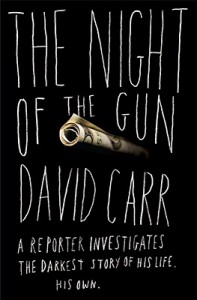
The Night of the Gun

Night-of-the-Gun_l

Initially, David Carr’s The Night of the Gun wasn’t a book I thought I would be interested in reading.  First, the title is very Soprano-ish, second, it’s another addiction memoir and third, it’s expansive (almost 400 pages).  As I started to read, I discovered that, yes the book was about his epic battle with cocaine and crack, but what I found more interesting was his attention to the fragility of memory.  How our memories, even the ones we believe as solid and unbreakable, can be nothing more than our attempts to hide our personal demons propagated with our desires to be someone else, someone better.  Such was the case on the night of the gun.  Carr steadfastly believed that on this night of binge drinking and cocaine indulging, his friend pointed a gun at him to make him vacate his friend’s apartment.  But when Carr dug deeper, it turned out his friend wasn’t the one with the gun, but Carr who wielded the .38 Special.  That false memory was the tipping point for Carr’s book.  As Carr stated, But if I was wrong about the gun, what else was I wrong about?

Thus began Carr’s journey, well actually more like in-depth reporting, on as what he dubbed as the darkest story of his life.  As impressive as his writing was, it was not as impressive as his exhaustive reporting, documenting, video recording and transcribing of all his interviews.  In the end, he recorded 19.3 gigabytes worth of material.  Astonishing.  All of this because he couldn’t trust his memory.  He wanted to get the real story, not just his version of what he believed happened.  He even hired an investigator to follow up behind him, just in case he missed any key facts.  For him, Memoir is a very personal form of creation myth, and perhaps less and less truthful.

That’s what made this book brilliant.  Instead of just writing about his struggle and the eventual overcoming of his addiction, Carr allowed the reader to step into his mind, to get his perspective and then flipped that perspective around, giving the reader the real truth, the really oh shit moment that truly happened.  By doing this, the reader can’t help but trust that Carr is giving them the rawest, most truthful account he can provide.  A couple of years ago, I read Augusten Burrough’s Dry and I thought it was a good book, although a tad bit sensationalized, about his own struggle with addiction.  After reading Carr’s book, I now wonder about the validity of Burrough’s recollection.  Burroughs didn’t do as nearly as much reporting as Carr did.  Honestly, it’s not just Burrough’s memory that has left me in doubt, but my own as well.  Carr’s book makes me question the accuracy of my memory and if what I’m writing about is really the truth, the whole truth and nothing but the truth.  The only way to tell, as Carr proved, is to dig deeper, to ask those uncomfortable questions and to listen to what actually transpired.

After reading this book, I’m left with the impression, that when writing a memoir, it’s important to choose the right story but more importantly, if not more, it’s getting that story right.

Share

The Gangster We are All Looking For

0375700021.01._SX140_SY225_SCLZZZZZZZ_Le thi diem thuy’s (according to her, she likes her name in lower case) The Gangster We Are All Looking For is not so much a biography but a collection of vivid poems beaded together to form a succulent narrative.  Although the book is a work of fiction, she borrows events from her real life (her assimilation to American life and the deaths of her brother and sister) to weave a powerful and moving tale of overcoming adversity and sorrow.
le’s background as a playwright is evident in this novel as she crafts tremendous scenes portraying the hardships her family endured.  Using simple but eloquent sentences, the majority of her paragraphs are no more than five or six sentences long.  Like clipping along a fast current, this style enhances the back and forth time and location shifts as she writes about her life in Vietnam as well as her life in America.  She prefers to paint the scenes with dramatic imagery rather than deliver a straightforward approach,

He would gaze beyond a person’s shoulder as though watching storm clouds gather on the horizon. Neither holding the clouds back nor inviting them on, his eyes merely took in their approach. More than once I have seen people talking with him turn around to see what was behind them.

As a Vietnamese writer, I understand and relish what some may describe as an over-dramatic style of writing.  The Vietnamese language is inherently flowery so when writes this Vietnamese English, I appreciate its complexity as well as its simplicity.  For example, she doesn’t just write about war, she allows the reader to partake, to suffer and more importantly, to imagine what war was like for her as well as her family.

Ma says war is a bird with a broken wing flying over the countryside, trailing blood and burying crops in sorrow. If something grows in spite of this, it is both a curse and a miracle.  When I was born, she cried to know that it was war I was breathing in, and she could never shake it out of me.

A good writer knows when you can show more then tell: show.  And does this wonderfully.

Even though the theme of the book is centered around tragedy, the book doesn’t bog you down in pity or deep reflection.  Structurally, it reads more like a fairy tale and an adventure novel.  By telling the story in brief, fragmented spurts, it keeps the reader’s attention and builds tension along the way.  As each scene unfolds, I found myself quickly turning the pages.  Her words, like morsels of good food, made me want to consume more.

Share

Hunger of Memory

14531604

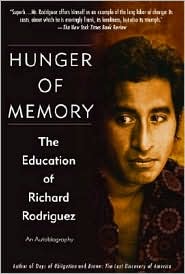
In his autobiography, Hunger of Memory, Richard Rodriguez breaks away from the expected conventional structure of an autobiography and instead weaves brilliant essays involving the subjects of education, assimilation, family and religion.  The title of his book, at first blush, suggests an intimate discourse in the retrieval of his memories but as the book unfolds, the main focus turns out to be more about cultural identity and alienation.

At first, I was a little stilted when I realized his autobiography was in the form of essays.  It was unexpected.  After reading Woiwode’s What I Think I Did, I was anticipating another narrative on the permeability of memories but Rodriguez chose to concentrate on the impact of cultural identity rather than what we remember or can’t remember.  Initially, I thought the essay structure was a brilliant. Since Rodriguez is a true intellectual with profound abstract thinking, the essays fit snugly into his complex style of writing.  The essays have an academic bent to them. Each chapter reads like a journal article from a scholarly magazine. The book, for the most part, lays out the foundation of Rodriguez’s societal, cultural and political beliefs.  He does write about childhood memories and experiences in his youth but each memory is self-serving to the chapter’s topic.  So in that regard, Rodriguez successfully conveys his points of view in an honest and objectified manner.  And it is in this objectification that presents a problem for me.  I feel the essay format is good to convey information and ideas but for a memoir, I thought the effect, over-all, was cold and lacked any intimacy.  While reading, I felt like I was a student in one of his lectures and he was using stories from his past to help further the theme of the lecture.  The stories were used as tools rather than centerpieces for the book.  It was too pragmatic.  The chapters felt distilled and disconnected.  Once I took out the brief and intermittent stories about his past, I was left with pages filled with intellectual ramblings.

After I digested his unconventional format, I was able to applaud his singular concentration to one topic and following it through.  At the end of every chapter, I knew where he stood on certain issues and how he arrived at his conclusions.  Everything he wrote served a purpose.  I paid attention to what stories Rodriguez used, how he wrote and the manner in which he wrote.  In writing this autobiography, I am actually describing the man I have become — the man in the present.  (p.190)

There is one section in the chapter, Achievement of Desire, I found peculiar.  Rodriguez switches from first person narrative to third person narrative.  While reading this chapter, I was often lost to whose voice I was reading about.  I didn’t know if the voice belonged to Rodriguez or Richard Hoggart, a modern educational theorist.  The switch takes place after the first excerpt of Hoggart’s description of the scholarship boy.  There were numerous times I couldn’t distinguish Rodriguez’s voice from Hoggart’s profile of the scholarship boy.  All of a sudden, both merged and became one voice.  I believe Rodriguez wanted to show the reader how much he identified with this profile.  He chose to do so by allowing Hoggart to speak for him.  The effect was startling but the reader gradually understands how Rodriguez intensely identified with the scholarship boy.  However, the abrupt manner in which he switches voice was awkward and confusing.

There were numerous times in this book where I felt Rodriguez was writing about my life.  Although a lot of his writing was in the abstract, he wrote about issues that affect most immigrants.  We deal with the issues of language and sounds, skin color, familial ties and alienation.  I know that I plan to write about these issues as well but I found Rodriguez’s take on them opened new viewpoints for me.

In his first chapter, Aria, Rodriguez starts off by the Anglicization of his name. I heard her sound out: Rich-heard Road-ree-guess. (p.9)  I read this part and couldn’t contain myself.  I don’t know how many times my name has been butchered.  But Rodriguez treats language as more than just incomprehension, he redefines our understanding of language as two parts: public and private.  Rodriguez manages to take language and break it down to empirical components such as sound and syntax.  From there, he expands on the emotional attachments to language and how it connects us to our families as well as our world.

The chapter on complexion was beautiful written.  His thoughts and the cultural biases towards dark skin are universal.  I felt that he was writing about my culture.  Rodriguez wrote about a time he overheard women talking about the misfortune of having dark skin and the gratitude that their children were light-skinned.  The way the women spoke, it seemed that dark-skinned children were afflicted with some kind of cancer.  He could have opted to personally describe his dark skin by inserting stories from his past, but instead he allowed the women, in particular, mothers, to describe the stigma of being dark-skinned.  This was much more powerful.  By using others to convey the bias towards dark skin, Rodriguez shows the reader the cultural perception of anyone suffering from dark skin.   The way he managed to weave the issue of dark skin into a narrative helped me to understand how I can achieve the same powerful effect in my own writing.

Overall, I thought Rodriguez autobiography was stunning and his writing is stylistic and impressive.  The times I enjoyed the book the most was when he would write about his childhood stories and relate them to the chapter’s topic.  When he would detour and got on his soapbox and start pontificating about his political views, I lost all interest.  He sounded egotistical and elitist.  With that said, I learned a great deal from his writing ability and the manner in which he engages the reader.

Share

This Boy’s Life

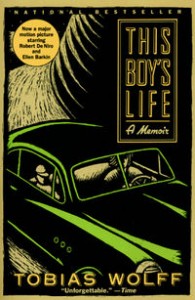
01_This_Boy's_Life_(Book)I tackled reading Tobias Wolff’s This Boy’s Life with a different gusto then I did with Andrew Pham’s Catfish and Mandela.  Paying attention to Wolff’s writing techniques and styles, I trusted my green highlighter to illuminate his writing prowess.  So after finish reading the book, I started to review the highlighted passages and realized I only had a couple.  How could this be?  I started to become frustrated that I had not paid more attention to what I was reading.  I was mentally kicking myself when it dawned on me: Wolff is such a brilliant writer that he got me to detour from my objectives and just pay attention to only his story.  So the question remains, how did he accomplish this?

In answering this question, I asked myself two questions: What is the thing and what is the other thing?  The thing is a coming of age memoir about a boy struggling to find himself.  The other thing is the taxing question of identity, alienation and escapism.  After these two revelations, other questions begin to surface.  How did Wolff manage to convey the thing and the other thing in his writing?  What writing techniques did he use?  How did he manage to detour me from my academic dissection to just enjoying the book?

Most notably, Wolff’s writing is simple but wittily composed.  In fact, there are no major dramatic plot twists or scenes in the book.  There are no far-fetched, grandiose similes or metaphors delving into the existential realms of identity, alienation and escapism.  Instead he uses a direct approach with uncomplicated, clever prose to recount his childhood.  He manages to make the memoir read like a novel.  Even though the time frame starts in the 1950’s, the narrative voice is young and contemporary.  This is important because it makes the reader feel like they are directly inside his character’s mind.  If the voice had been passive and reflective, in other words, older, then the tone of this book would have dramatically changed.  The times he changes to a more contemplative voice, the tone suddenly becomes more remorseful and regretful. (p. 27 and 121).

He establishes a youthful tone by referencing popular trends associated with adolescence.  As a child, Wolff’s character is preoccupied with guns and warfare.  Most young boys share the same fascination.  Wolff makes sure to emphasize that his first gun is his mother boyfriend’s, Roy, childhood gun, a Winchester .22 rifle, Roy had carried it when he was a boy and it was still as good as new.  (p.23)  Then the manner in which he builds a fortress and targets passersby that come within his sniper range all conjure images of a young boy playing soldier.  (p.24-26)  Even as Wolff transitions from pubescence to adolescence, he still reminds the reader that his character is still young by referencing The Mickey Mouse Club.  When Wolff and his friends watched the show, they lost their pretend grown-up demeanors and reverted back to being kids, We surrendered.  We joined the club.  Taylor forgot himself and sucked his thumb, and Silver and I let him get away with it. (p.44)  Then as a teenager, Wolff details his character’s youth by describing his inexperience, “when they discovered that I’d never been drunk and still had my cherry. ” (p. 184) By simply showcasing youthful anecdotes, the tone of the book stays young and contemporary.  I felt as though I was living out the same experiences alongside Wolff.  This made the reading light and palpable.

One technique that I noticed Wolff used to change his direct voice to a more passive voice is his use of quotation marks.  For example, he has a section where he and Roy discuss the possibility of a little brother.  Wolff uses quotations at the beginning and the end of the dialogue but noticeably absent in the middle. (p. 29)  He does this again in a conversation with his mother after their first visit with Dwight. (p. 67)  Although very subtle, it made me wonder why he would choose to employ this technique and what purpose it served.  By omitting the quotation marks, I believe Wolff wanted the reader to understand how removed he was from the conversation.  The reader feels how distant Wolff felt at that moment.  Wolff wanted to convey insincerity in his response, the same way we answer a question just to appease the person asking the question.  And in these paragraphs, Wolff does just that.  This technique is very clever and in my opinion, draws the reader deeper into the character’s thought process.  Just by removing the quotation marks in the middle of the conversation, Wolff is able to convey a mood without breaking the rhythm or pace.  The conversation continues but the reader can now visualize subtle inflections in the voice.

The most impressive aspect of Wolff’s writing is his consistent emphasis on his struggle to find his identity and his desperate need to escape, physically and mentally, the world around him.  As I mentioned earlier, Wolff doesn’t use any convoluted, complex metaphors to describe this struggle.  It’s straightforward and honest.  So honest, in fact, Wolff tells the reader on several occasions he is a liar and a thief. (p.62,133)  Wolff skillfully supplements these declarations with poignant examples throughout the book.  He layers these examples one after another so the reader has no doubt to the central struggle of the book.  Every story relates to the other thing.  He doesn’t digress.  His writing is focused and centered.

The main prevailing thought I am left with after reading Wolff’s book is that good writing doesn’t have to be complicated and convoluted.  Good writing is beautiful constructed sentences simply organized to give the reader a clear view of the message the writer is trying to convey.

Share

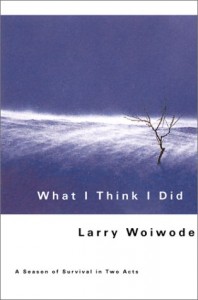
What I Think I Did

41CPSC1ESTL

This is not an actual review but a question posed to me about Woiwode’s experience as a novice writer in his book, What I Think I Did.

As a novice writer, I felt such kinship reading about Woiwode’s struggles and triumphs as a writer.   There are two statements Woiwode writes that encapsulate the hurdles of a young writer,  because the search for words in a beginning writer is as elusive as the search for physical expression (p.209) and What a writer often needs, and especially a beginner, is an answer to technical difficulties. (p.259)  Woiwode definitely got an amen from me as I read those passages.  I find that as I write, or in many cases try to write, I am searching for those words that easily slip off my tongue but find difficulties finding their way home on a blank page.  Forget horror movies, a blank page is the scariest thing for me.  Then there are the questions that creep up, the technical ones.  I can see the image in my head but how do I translate that image to words with the same technicolor magic?   I feel that I often overkill with details and as Scouffas tells Woiwode I over-reach.  But on the flip side, I feel that if I simplify things then I’m losing the intensity of the scene.

I think we all unilaterally regressed back when we read the passage about Woiwode’s experience of rejection when he turned in his first writing submission.  I’m breathless, as eager amateurs are, though they have the confidence of peacocks in displaying themselves€  (p.124)  It’s doesn’t matter whether it’s your first rejection or your tenth one, the sting still hurts.  Even as a more experienced writer, Woiwode received harsh but critical reviews, Larry, either my judgment is failing me or this the worst thing you’ve ever written.  (p. 186)  Ouch.  But as the old adage goes, what doesn’t kill us, makes us stronger.  I could write a book on rejection and feelings of inadequacies.  Hmmm…

I think the best advice given to Woiwode on learning how to write is the ever-present question, Isn’t there a simpler way of saying that. (p.259)  For me, this has become my mantra, my chant, and my meditation.  As I am learning the nuances of good writing, I find that the Zen approach to writing, less is more, is pervasive.  You don’t have to look no further then Tobias Wolff’s This Boy’s Life for a beautiful example.  What I’m struggling with is finding the balance, trying to get my point or the image across like a haiku but without losing the intensity of emotions.  More often than not, I feel as I edit my work, I feel as if I losing my children in the process.  I just got to learn to let go.

server crawl test .

Share

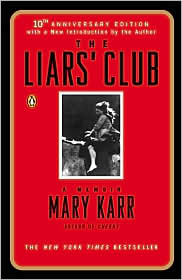
The Liar’s Club

13775438

Mary Karr’s The Liars’ Club is easily the best memoir I have read thus far.  Initially, I thought her style read very similar to Tobias Wolfe’s This Boy’s Life and then come to find out ,Wolfe helped her edit the book.  Regardless, Karr carved out her own style and truly original voice in this book.  I approached this book different from the other books I have read.  Instead of highlighting and dog-earring excerpts that exhibited brilliant examples of writing (if I did that here, the book would have been painted bright yellow and filled with folded pages galore), I decided to read the book without interruption and let the impact of Karr’s writing dictate my critical response.  What impression did the story leave?  How did Karr’s writing make me thirst for more? Why couldn’t I put this book down once I started to read it?  I believe the key to the success of this book is Karr’s writing is less like writing than it is conversational.  I feel like she is telling the story rather then remembering it.  There is no judgment or moral implication nor does Karr strive for any.  It’s straightforward and un-complicated.  The language is tremendously simple yet ingenious.

Karr is also a published poet and her poetic style is evident in her writing.  Unlike Larry Woiwode’s What I Think I Did: A Season of Survival in Two Acts (whose book I thought was brilliant), her style of writing is more fluid and informal.  I especially love her use of parenthesis to inject her insight or clarification in the middle of a paragraph.  This technique made me feel as if she was whispering a secret.  It established a wonderful intimacy and made me trust her.  Using the parenthesis allowed her to warp time and add relevant information from the past, the present or the future.  She managed to weave different stories together without making the reader feel dizzy or lost.  She could be talking about her mother and then jump to her father’s reaction and then springboard to her sister’s response without losing continuity.   Her success was the fact that all the stories were related and helped support Karr’s main idea.  The main story was like a trunk of a tree and the side stories were like the branches.  It all connected together seamlessly.  Karr’s approach was systematic.  She would write about her memory of an event and then supplemented that memory with different family member’s reaction.

I think the times when I enjoyed the book the most were when she would write about her sister’s reactions to her follies and fumbles.  She could have easily just wrote about the events and described it in her own voice but instead she cleverly chose to allow her sister’s, Lecia, comments to describe the lightheartedness or seriousness of the subject.  There were several times where Karr would write – If Lecia was writing this or Lecia states – that I found myself relishing these tidbits of outsider knowledge because it peppered what Karr was writing.

Karr wr0te the book mainly through the perspective of a younger Karr.  She later fast-forwarded the perspective to an older self towards the end of the book when she dealt with her father’s death.  Karr’s younger self is a strong character in the book.  This book is definitely character driven, even though there were many events that take center stage.   She carries her child perspective even when she writes about being molested as an eight year old.  This was probably the most powerful story in the book.  I literally almost skipped this part because the way she describes the molestation put me in the reference of a small child.  It was almost more than I could bear.  Her honesty and objectivity of this story was truly astounding.  She didn’t break away from her character and didn’t add any social commentary.  She wrote about it in the same way she wrote about horseback riding or shooting a gun.  And that’s what made this story that much more powerful. Karr’s succinct and direct approach is truly inspirational.  There was no hint of remorse or condemnation one would expect in her story telling.  The reader is left with the magnitude of the situation without any forceful diatribe from Karr.  I was left speechless and in awe.

For the longest time, I looked at David Sedaris’ writings as a model for how I would like to write but after reading this book, I have found a new inspiration.  Her similes and analogies made me say wow and that was great out loud so many times I sounded like a broken record.  Reading Karr’s writing, I understand the powerful impact of well thought-out images or similes.  Consistency with an image is crucial.  I know that Karr’s experience as a poet helped her writing, but the fact that she knew when to reign in superfluous analogies, I believe is her strength.  She wrote in simple terms but cleverly constructed so that the reader wasn’t jumping from a simple image to an ornate one.  She wrote every detail with crisp everyday language.  And to spice things up, she would insert local colloquialism that added humor and originality to the story.

Share

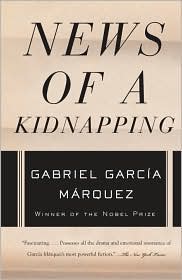
News Of A Kidnapping

24656514

In a New York Times review in 1997 critic Michiko Kakutani wrote, News of a Kidnapping not only provides a fascinating anatomy of one episode in the biblical holocaust that has been consuming Colombia for more than 20 years,’ but also offers the reader new insights into the surreal history of Mr. Garcia Marquez’s native country. Indeed, the reader is reminded by this book that the magical realism employed by Mr. Garcia Marquez and other Latin American novelists is in part a narrative strategy for grappling with a social reality so hallucinatory, so irrational that it defies ordinary naturalistic description. How does this nonfiction account display Marquez’s skill at this narrative strategy?

OK, initially when I read this question and came upon the word magical realism, the first images that appeared in my mind were characters from The Chronicles of Narnia or Lord of the Rings.  In short, fantasy writing.  I can’t help but to associate the word magic with a mystical and fantastical universe.  Not the E.T. kind but like a yellow brick road kind.  Elves, sprites, wood nymphs and witches inhabit this land and good and evil battle ferociously to the end.  But then I thought, Marquez surely couldn’t be writing about fantastical viagra online for women characters when the subject of his book is mainly about the Colombian (I hate when people spell this with a u) drug world.  But in a way, he does.  GGM (Gabriel Garcia Marquez) does manage to inject bit of magic in the harrowing stories of the victims as well as the perpetrators.  I found that the parts of the book I like the most (and I actually did like this book) were the parts where my jaw dropped and my head shook in disbelief at the fantastical accounts captured by GGM.  Even Kakutani noted in her review the absurdity but nonetheless realistic portrayal of Escobar by his fellow countrymen – “kept a zoo with giraffes and hippos brought over from Africa, and where the entrance displayed, as if it were a national monument, the small plane used to export the first shipment of cocaine.”  You’re kidding me.

viagra jelly for sale

But I think in the case of this book, I don’t think it should be characterized as magical realism but magical journalism.  GGM has been quoted saying his most important problem has been to destroy the line of demarcation that separates what seems real from what seems fantastic.  This book does read like a journal article packed full of details.  No one can say GGM didn’t do his research.  Some may say he included every little bit of detail he could find in this book.  But I have to say; I did read this book in a couple of sittings.  Yes, at times, I had to refresh my memory as to all the characters but I was fascinated about the mindset and rationale that kept the victims alive and their spirits up.  And that was in large part due to their religious as well as their spiritual beliefs.

Magical realism takes fantastical elements and weaves them into a story with deadpan seriousness.  In the book, GGM describes how the victims and relatives of the victims have hallucinations and prophetic dreams.  How they are sometimes bathed in supernatural light.  How they pray to the Virgin Mary for protection.  And death-bringing butterflies.  As fantastical these beliefs may be, they are everyday occurrences for the characters in this book.  I don’t know if it’s because the culture lends itself to accept these unnatural occurrences as normal but GGM surely depicts them as so.  If these elements were lacking in the book, I doubt that I would like the book as much.  I also loved how GGM would contrast the gravity of the situation with a thought or an undercurrent so ridiculous it seemed that it was an invention of his imagination rather than a truthful account.  For instance, when Pacho Santos was kidnapped, the abductors were racing through the streets not only for security sake but also to try and catch the soccer game that was airing on T.V.  And the fact that Beatriz and Maruja were thrown parties on the day of their escape as if they were actual guest instead of captives.  Could you imagine this happening in the US?

And finally, how could we overlook the fact that it took a priest with supernatural abilities to convince Escobar to surrender.  He was a priest who was considered a saint and had the supernatural ability to talk with the waters and control their movement.  C’mon talk to the waters?  And finally, my favorite paragraph in the book, Don’t worry about me, my boy, he shouted to Villamizar, I control the waters.  A clap of thunder rumbled across the vast countryside, and the skies opened in a biblical downpour.

It doesn’t get any better than this.

Share

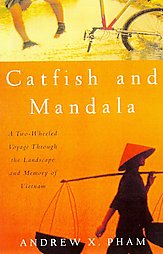
Catfish and Mandala

0374119740

Catfish and Mandala, a memoir by Andrew Pham, details the journey of a Vietnamese American struggling to reconcile his Vietnamese heritage with his American ideologies.  Born in Saigon in 1967, Pham was raised in a moderately affluent household by Vietnamese standards.  His parents are educated, notably his father who is fluent in French and English.  Pham is the oldest son, the second of five children.  With middle class standing, his parents manage to secure some financial stability.  After the war, his family lost everything.  In 1977, he and his family narrowly fled Vietnam.  Pham was only viagra online no prescription buy viagra in us ten.  In his memoir, he voyages back to Vietnam in an attempt to rediscover his Vietnamese identity and more importantly, to harmonize his American identity with his Vietnamese past.

nolvadex online

Virtually destitute, Pham’s emotional return to Vietnam is not typical of a viet kieu, a Vietnamese living abroad. Where as most viet kieu travel back to Vietnam laden with gifts and cash, Pham is empty-pocketed with barely enough money to sustain him.  In addition, his choice to travel through Vietnam by bicycle absolutely stuns his relatives. He battles crippling dysentery, numbing fatigue and debilitating hunger during his trek from Saigon to Hanoi. Traversing the varied terrains of Vietnam on his bicycle, Pham visits his childhood haunts. Each visit triggers a torrent of emotions. Pham discovers most of his childhood stamping grounds have been relinquished to squalor or urban development.  While the topography tests his physical endurance, it is the natives who test his spirit and resolve. Pham encounters distant relatives, devious tour guides, street urchins and ominous ruffians.  Each encounter takes an emotional toll.  In this journey of self-discovery and renewal, Pham comes to terms with his past, his identity and most importantly, his place in this world.

Pham’s descriptive details are awe-inspiring.  He describes each scene like an artist painting with vivid colors.  The images jump off the pages and the reader is immersed in a culture steeped with tradition, contradictions, irony and admiration.  This is not a typical travel memoir describing beautiful sunsets and charming resorts. Pham’s memoir is intimate, raw and honest. In his story telling, he is not biased towards Vietnam nor is he prejudicial towards America.  His unique perspective as a Vietnamese American allows him to view Vietnamese culture as an insider as well as an outsider.  He understands the language, the customs and the mindset of the Vietnamese people. On the other hand, his American upbringing allows him to disengage and contrasts Vietnamese values with his American ones.  It is this dichotomy that makes his story so engaging.

Pham writes with such clarity he transforms the reader from a passive observer to an active traveling companion.  The reader experiences Pham’s every emotion, struggle and accomplishment.  The key to this connection is that the reader trust Pham’s account.  His description of the Vietnamese people and culture surpasses his memory and familial recollections.  His rich details of the history and topography of each city he visits are proof of his diligent research.  His inclusion of local points of interest personalizes each place making each one memorable and enduring to the reader.  This book is more than a travelogue; it’s an intimate diary of discovery.

In his memoir, Vietnam is portrayed through Pham’s eyes. Uncensored and unobstructed, there are times when this view is abrasive and unsettling.  However, it is important he includes this seedier side of Vietnam.  If Pham’s homecoming only consists of embracing family reunions then this book loses its refreshing honesty.  It is this honesty that draws the reader in.  The reader is engrossed in Pham’s day-to-day trials and tribulations.  Pham makes the reader squirm in reaction to his swallowing a snake’s heart then makes the reader cheer when he stands up to local bullies and con artists.  The fact his stories evoke an emotional response from his readers is a trademark of a skilled writer.

Pham’s choice to travel on bicycle speaks of his unconventionality.  It is poignant he chooses a mode of travel that is inherently difficult.  His physical struggle parallels his emotional one.  When his physical perseverance is taxed to the limit, his emotional tenacity concurrently wanes.  Whether on purpose or happenstance, Pham chooses the most common mode of travel in Vietnam but the least utilized in America to retrace his heritage.  As an American, the assumption would be that he travels by vehicle or have professional guides help him.  Instead, Pham’s solo two-wheeled journey connects him on a grass roots level to a country he is longing to belong.  The story would lose its appeal if Pham had been chauffeured to the origins of his childhood memories.

Pham weaves stories of his family throughout his memoir, notable the story of his older sister, Chi. The conflict of reconciling one’s culture with one’s identity is profoundly illustrated with his sister’s own turmoil.  Being the first-born and a female, his sister’s life commences as a disappointment to her father.  It was not until she had a sex change did she receive some acknowledgement from her father.  However, acknowledgement is not the same as acceptance.  Alienated and depressed, Chi commits suicide.  Her family later dubs her suicide as an accident.  She started her life feeling like an accident and ended her life as one.  Chi’s struggle of acceptance and belonging is the same undercurrent that motivates Pham’s journey back to Vietnam.

The charm of this book lies in the vivid details.  Pham’s story telling is succinct but in that brevity he packs in a tremendous amount of information. The reader trusts Pham’s authority on Vietnamese culture.  He writes in a confident and assured voice.  His writing is universal in that readers unfamiliar with Vietnamese culture can still understand and follow the story’s progression.  While Asian, especially Vietnamese, readers can relate and compare Pham’s experiences with their own.

Share