South Florida Asian – A Rare Breed

If I were to write a personal ad, it would go something like this: short male, black hair, brown eyes, caramel-colored skin…then I would probably go on at length about my sculpted body and model looks…ok so that’s more wishful thinking than anything.  If you came across my profile, you wouldn’t hesitate to think Latin male right?  The dark features and tan skin are dead giveaways.  But what if I added slightly oval eyes, like large almonds, what would you think then? Asian?  In South Florida?  No way…there are no Asians in South Florida.  Perhaps not many, but there are.

Yes I’m Asian, more specifically Vietnamese.  I moved to South Florida after finishing college in New Orleans.  In New Orleans, you couldn’t walk a couple of feet and not bump into another Asian.  Not the case down here.  Every once in awhile I would spy another Asian and then a slightly awkward exchange occurs.  First there’s that moment of disbelief.   Did I just see another Asian?  Or was it a mirage, like when you’re driving and you swear the road looks wet.  After a couple of double takes confirming that they are indeed Asian, a serious stare down ensues.  A silent game of guessing their nationality commences. Side note here…for those who say they can distinguish the different Asian nationalities…you can’t.  I get mistaken for Filipino all the time.  After the stare down, a couple of things can happen…both parties do nothing or they give simple nods acknowledging each other’s presence or a pretense to finding a spec of dirt on the floor interesting so one party can move in closer.  If greetings are shared, the indubitable questions are asked: where are you from, how long have you been here, you know there aren’t a lot of Asians in South Florida, etc.

Living in South Florida, Asians are definitely a minority.  You would think the tropical weather would be a magnet for Asians, but for some reason, the azure beaches aren’t much of a draw.  Due to proximity, Latin and Caribbean cultures dominate.  I took French in school, but much good that does me down here.  I quickly learned to ditch “bonjour” for “hola.” In no time, saying “mira” and “ay dios mios” required little effort.  And the one thing I’ve learned living in South Florida is people are divided into two categories…Latin or Not Latin. And if you have the slightest resemblance of being Latin, you’re presumed to be so.  People approach me all the time speaking Spanish at full throttle.  There’s no point in saying, “Yo no habla espagnol” because the response I receive is, “Si, tu habla espagnol!”

One line does not a fluent Spanish speaker make.

So what I usually do nowadays is point to my eyes, the obvious sign that I’m Asian.  Sometimes that’s enough to convey I’m not a Spanish speaker, but more often than not, the person looks up and continues to hurl Spanish words at me.  Confusion sinks in.  Should I be offended that they’ve ignored my Asian identity or impressed that they are so willing to accept me into their culture?  No Salsa or Meringue auditions, no flan making test…who knew that the mere utterance of  “que tal” is the Spanish equivalent of “open sesame.”

As an immigrant myself, I find that I have more in common with my Latin and Caribbean neighbors than I ever thought possible.  The chorus of the immigrant song is a familiar tune no matter where you are from.  Some immigrants have escaped oppressive regimes.  Others, who at any costs, risked their lives to ensure brighter futures for their families.  It’s why I understand the push for the Dream Act.  When mothers recount their struggles to get their children to the US, I see my own mother.  Fathers are channeling my own when they talk about overcoming insurmountable obstacles.  I see Haitian refugees on rafts and it reminds me of the throngs of Vietnamese refugees escaping after the war.  What if my family were turned away?  Where would I be today?  Even though, I still find it hard to add “American” after “Vietnamese” when describing myself, I’m grateful that I have the option.  Many would gladly change places with me.

So I have chosen to live in South Florida where the nearest Chinatown is over 1,000 miles away and perhaps, I don’t see people that look like me very often, but you know what…I’m ok with that.

Latin spices, Caribbean flavors, beautiful beaches…in retrospect I think I’ve gained more than I’ve lost.


This article was published by WLRN.  The link is here:

http://wlrn.org/post/being-asian-south-florida-means-disbelief-stares-and-latin-confusion

 

Share

Mistaken Eye-dentity

This time, it happened as I was exiting my car and walking towards an office building for a meeting.

“How many trucks do you have, Leonard?,” this 40-ish looking man, standing in front of the office doors, shouted at me enthusiastically.

I didn’t recognize him.  I turned around to see if he was talking to someone behind me.  No one.  When I approached the doors, he ovaled his arms to give me a hug, but when I stepped back, he stopped short, his hands suspended in the air like he was dancing with an invisible partner.

“Oh I’m sorry,” he said.  His hands deflated to his sides.  “You looked like an Asian guy I know.”

The time before this, I was changing in the locker room, when a man came up to me and buddy punched me.

“Hey man, long time no see!”

“I’m sorry, but I think you got the wrong guy.”

“No way, you don’t remember me?  I’m your massage therapist.”

“I’m sorry, but I think you got the wrong guy.”

“No way man.  I remember you.  You need to book another appointment!”

His insistence made me wonder, for a slight second, if he indeed was my massage therapist, but I knew I never met the man.

“I’m sorry, but I think you got the wrong guy.”

“You’re sure it wasn’t you?  It was an Asian guy,” he told me assuredly, almost as if I needed reminding.  I finished dressing and walked out.

Millions of Asians worldwide and I just happen to look like every one of them.  People see my eyes, my hair, my skin color and instantly I’m the Asian they’ve seen on TV, the Asian they work with or the Asian they went to school with.  I never knew I had the universal Asian face.  This must be the reason why I’m the subject of so many cases of mistaken eye-dentity.  Because if it wasn’t for my eyes, how would they link me to an entire race?

Recently, I was at my company’s Christmas dinner and while I was sitting at the table, one of my co-workers mistook me for Bohn, the other Asian in the office.

“Hey Bohn,” she said to me.

Everybody at the table looked at her, then at me.  No one corrected her.  Perhaps she just confused our names, but then she continued.

“Bohn, who’s that guy sitting next to Mary Ann?”

The guy she was referring to was actually Bohn’s co-worker.

“That’s Sean,” I said.  “He works with Bohn.”

She glared at me.  The confusion switch flipped on.  At first, I wasn’t sure if she thought I was the type of person who referred to myself in the third person.

When Bohn talks, Bohn likes to address himself as Bohn.

But then it dawned on her, that perhaps I wasn’t Bohn.

Bohn and I are roughly the same height, but that’s where the similarity ends.  His hair is almost shaven, while mine is spiky with a punk silhouette.  His skin tone is darker.  He’s more rotund.  He’s Cambodian.

In my opinion, we look nothing alike, but the fact that we are both Asians made us indistinguishable.  When I left the table, still unconvinced, my confused co-worker turned to the table and asked, “That’s not Bohn?”

I know people have cases of mistaken identities all the time, but the frequency of it happening to me is quite high.  Is this just an Asian phenomenon?  After all, Asians have amassed a worldwide population of almost four billion.  I’m bound to remind someone of an Asian they know.  But the curious fact is that not one Asian has confused me for another.  Do Asians see the differences that are obvious to us, but are subtle, if not invisible, to non-Asians?  Perhaps it’s the same way specialists discern stripe or spot patterns in tigers and leopards.

When other co-workers approached me a couple of days after the Christmas party, they were still tee-heeing about the incident.  “At least she got the Asian part right,” I told them.  If she had confused me with Sheldon, my black co-worker, then perhaps then I might be slightly worried.

Worried not for me, but for Sheldon.

After all, can he handle being the poster boy for the Asian community?


Share

Other Is Never a Good Category

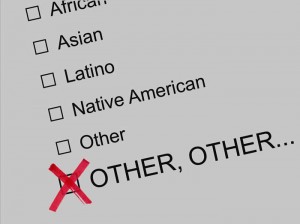
OtherOtherFront_001In middle school, my teacher, every once in awhile, asked all the white students to stand, followed by all the black students and then she tallied the results.  At the time, there were only two Asians in the class: a Vietnamese girl and me.  We both looked at each other, not knowing if we should speak up.  This purgatory confused us: we didn’t know what group we belonged in.  We were more white than black, so did that mean we should be included with the white students?  Then again, the black students were considered minorities, so it was probably more appropriate for us to join their group.  To make matters even worse, the teacher neglected to even include us, which made our status even more ubiquitous.

It turned out, the teacher was conducting a survey of the ethnic makeup of the class.  She saw the class as black and white, with no shades in between.

When we did speak up, she looked at us, her eyebrows cocked unevenly as she wondered how to categorize us.  She wondered out loud what box she should place us in.  She took some time and decided to include us with the white kids.  The first time we didn’t argue.  However, the second time she conducted the count, I decided to take a stand.

“I’m not white,” I said, “Nor am I black.”

She stuck her pencil in her mouth and began to chew on the eraser.  My words, like water dripping from a crack, seeped in her mind.

“Don’t you consider yourself white?” she asked.

I shook my head no but secretly I had been.  My friends were white and everything I’ve come to associate with America thus far had been through the perspective of a white American.  But for some reason, this time I wasn’t content to being lumped together with a group of people that was completely different from me.  Something was nagging me to be more authentic.

“What do you consider yourself as?” my teacher demanded.

“Vietnamese,” I replied.

“There is no category for Vietnamese.  I will just have to make another category and label it as other.”

Other, the catchall category that combines together every ethnicity other than black and white.  It’s the closet you hide all your junk in when you want to do a fast clean up.  I hated the word other.  It always connoted something that wasn’t a first choice: the other women, the other friend, the other child.   I didn’t want to be other.

“Can’t you write Vietnamese instead of other?” I asked.

She looked at me, her lips pursing as if she just licked an invisible lemon.

“No, I can’t because then I would have to write something different for everyone.  It’s easier to just write other.”  She said this congenially like a parent convincing a child to eat his vegetables.

“It’s not that important anyways,” she added.

At the time, I was hard press to argue otherwise.  Being Vietnamese was the least of my priorities.  If a friend had a plastic Superman watch, I wanted one.  If one had a GI Joe lunch box, I wanted one.  I was taking my cues on how to be an American from them.  I tried to dress like them – I even wore cowboy boots with shorts because a friend did so, much to the ridicule of my siblings.  I tried to get my parents to buy a set of Encyclopedia Britanica because after all, according to the brochure, almost every American family had a set.  I tried to match our thrift store bed linens together, so that our beds would look like the model beds showcased in houses christened the American Dream by television commercials.

But my family showed no interest – they cared less about encyclopedias and were happy with the mismatched sheets and pillowcases.  It was hard for me to be an American in a Vietnamese family.

It didn’t help that my mother planted her rau muong or water spinach in the ditch in front of our house.  Similar to the texture of spinach, rau muong is a popular staple in Vietnam.  It only needs a steady supply of water for it to grow so when my mother saw the ditch, she knew it was a perfect place to plant it.  In no time, my mother had a nice crop of rau muong sprouting in front of our house.  When she wanted some, she headed out to the ditch and snip the stalks with scissors leaving the roots behind.  Freshly clipped, the tips of the roots poked out of the ground liked newly transplanted hair plugs.  When my friends came over, I never mentioned the garden.  To the untrained eye, the plants looked liked over-run weeds.  My mother usually picked the plants in the evening before dinner, so I didn’t have to worry about my friends ever seeing her, but once she decided to pick the plants a little earlier and as chance may have it, my friends and I happened to walk by.  They saw my mother in the ditch, squatting on her haunches toad-like, snipping away.  All she needed was a conical hat and you could imagine her planting rice in the waterlogged fields of Vietnam.

“What is your mother doing?” one friend asked.

“Nothing,” I quickly replied.

“Does your family eat grass?” another questioned.

“No, we don’t eat grass,” I replied angrily.

“It looks like grass to me,” the friend said.

The rest nodded in agreement.  That’s how it came to be that my family ate grass.  A running joke that surfaced when any of my friends cut their lawns, how they would save the clippings for us.  If I had been savvier, I could have retorted with a clever comeback. My mother was using the exotic miniature leaves as garnish or in a wedding bouquet or that she was a horticulturalist conducting research. But I wasn’t very clever, so I endured the ribbing.

After much pleading, my mother later moved the garden to the backyard.  I figured if I couldn’t uproot my past, I could uproot the garden. The garden didn’t last and the plants died.  She never grew rau muong again. From then on only cooked what she bought at the store.  My mother never expressed her disappointment in the garden or in me.

Share

What’s in a Name?

images

I remember a poignant scene from the movie What’s Love Got to Do With It? where Tina Turner is divorcing Ike Turner and she’s willing to give up everything as long as she gets to keep her name.  All I want is my name, she said proudly.  Her name meant more to her than all her riches or her royalties.  I sat there watching this scene thinking would I do that?  Would I give up everything for my name?

Recently, I had dinner with a friend who has his family crest tattooed on his forearm.  His family name proudly scripted in large letters above the shield.  Inked in a visible place, his crest demands attention.  He tells me if his older brother didn’t have a son, the family name, the one emblazoned on his skin, would be lost.  It’s up to the son to pass on the name.  Such pressure on this child, I thought.  The burden of a family lineage resting on his shoulders.  What if he turns out like me?  Someone who is willing to change his name to assimilate and blend in.  If I have to attend an event where I have to wear a name tag, I spell my name Lee minus my last name.  I am transformed into a one-word name like Elvis or Sting. The transition to becoming Lee, an American who grew up in the south, who graduated with a Biology degree, who enjoys living by the beach, is easy.  It’s more difficult to be Ly, an immigrant from Vietnam who struggled to  learn English, who rounded his eyes in the mirror, who tried to change his name.

I think about my mother whose maiden name I didn’t learn until I had to use it while filling out paperwork for my first loan.  When she got married, her name dissolved, like sugar in hot tea, into my father’s.  For nearly fifty years, no one  called her by her first name.  Even her own mother opted to call her ma lan or mother.  Many years later, when she left my father to live with me, I was caught off-guard when my neighbors greeted my mother by her first name.  I’ll admit that I was surprised, if not a little angry, when she acknowledged her name.  In my mind, that name didn’t exist except only on paper.  I realized, all those years, I never connected my mother to her name, never saw her as an individual, a separate entity apart from my father or my family.  When my neighbors said her name out loud, I stopped in mid-step, my auditory senses triggering my visual ones and an independent woman appeared, someone completely different from the woman who raised me.  Her name, one I didn’t even think she would even recognize, suddenly took form.  What dawned on me was that there was no way my neighbors could have known her name unless she told them.  They must have asked her what her name was and she must have replied, Gam, pronounced like gum but with an accent.

My name is Gam, I imagined her saying in her staccato English.  It’s almost inconceivable that she could ever express such words.  But she had to and by the looks of her exuberant behavior, it was something she has wanted to do for a long time.  Reclaiming her name, after so many years of denying or hiding it, has brought about an unbelievable change, imagine Lynda Carter spinning as she transforms into Wonder Woman, only not as fast.  The pride she feels in her name is infectious.  Well, almost.  Can I say I have the same amount of pride newly discovered by my mother?  I can honestly say I don’t know.  I have accepted my name and have grown to appreciate its uniqueness but I still don’t correct people when they spell my name Lee.  I let them discover the correct spelling on their own.  The reaction is always the same, Oh, I didn’t know you spell your name L-Y. I would smile, not offering much of a defense.  Perhaps I have to lose it, like my mother did, to know the value of it.  Then maybe and that’s a big maybe, I would even have the courage to tattoo it on my arm. ip address

Share

Life and Death: The Vietnamese Way

260xStory

Asians, especially Vietnamese, are very peculiar about the notions and perspectives surrounding death.  For example, I was shocked to discover that Americans and perhaps, most citizens of the Western world do not photograph funerals or wakes.  It never occurred to me that this might be considered odd or at the very least, morbid until a friend was completely shocked when I showed him pictures of my grandmother’s funeral.

Why would you take pictures at a funeral? he asked, shaking his head in disbelief.

Why would you not? I indignantly retorted back.

I’ll have to admit, weddings, funerals or any large get-togethers give my family an opportunity to use our cameras.  Constant picture taking has strengthened our index finger to the point that it is second nature for us to press down on any shiny metallic button.  In fact, our picture-taking reflex is almost autonomical like blinking or breathing.

Growing up, my family used to receive pictures from funeral services of relatives in Vietnam.  The pictures were usually the same: black and white photos of relatives standing over graves or caskets looking grim and sullen.  On occasion, the accompanied letter would sometimes describe grief stricken family members trying to crawl in the casket of the deceased.  Whenever we got those letters, it would always spark a debate among the children as who in the family would be the casket crawler. Somehow I was always chosen being that I have a flair for the dramatics.

When my family got these funeral photos, we didn’t flinch or wince.  To us, morosely, it was like receiving a postcard but instead of saying, Wish you were here, ours would say, Wish your uncle was alive or Wish your cousin was here to enjoy this.

Vietnam is not only physically on the opposite side of the world from America, it’s also its philosophical opposite.  Most funeral services in America consist of mourners wearing black attire.  Men dressed in black suits and dark ties, women in black dresses and the occasional black veil.  Traditional Vietnamese funerals are contrastingly different.  If you ever walked in on one, you would probably stop dead in your tracks (no pun intended).

The most striking contrast is that Vietnamese mourners do not wear black: we wear white.  Well, I should clarify: the immediate family of the deceased wears white.  While Americans traditionally view white with weddings, Vietnamese associate white with funerals.  Red is the color of choice for weddings as it represents prosperity and luck, while white represents loss and a passing of life.  The color white symbolically represents the ashes of the deceased.  Since most Asians are cremated, it’s more appropriate for funerals than black.

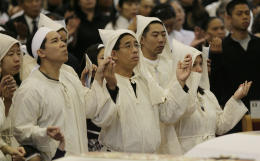
When you attend a Vietnamese funeral, you’ll notice the deceased’s immediate family is sitting or kneeling in close proximity to the casket.  However, it is not the close distance that immediately draws your eyes but the traditional mourning regalia: white robes, pants and pointed hoods.

The outfit consists of white pants that billow out like over-sized pajama pants, a white wrap-around tunic that makes anybody who wears it a Samurai double and last, but not least, a white, pointed hood.  The hood is simple in design, two pieces of white cloth sewn together to form a pointed end, long enough to cover the neck but exposed in the front to show the mourner’s face.

Unfortunately, when I mention white, pointed hoods, it conjures images of the Klu Klux Klan.  However, the biggest difference is that Vietnamese are not ashamed to show our faces. Amazing how iconic a white hood is in American society that it immediately evokes feelings of hatred and animosity.  Asians view a white hood as sorrow and loss.  I guess, by the same token, Americans probably feel the same.

To Americans, talking about death is taboo but to my family, it’s connecting a duality.  Death is just as much a part of life as is the reverse, a delicate interwoven tapestry.  There is a balance as fine as a silk thread that has long been revered by us.  When we take pictures of funerals or wakes, it’s not to be macabre but more like a quiet reverence.  The pictures show the deceased was just as important in death as when they were alive.  When we are older and our memories begin to fail, we are comforted knowing that we have our pictures to show us the full panoramic view of our loved one’s life.

Share

Caught Red-Handed

522456195_357ce496d6_m

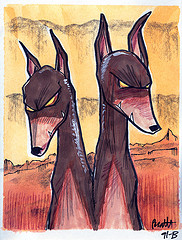
During the week, viagra tablets I pretty much stick to the same morning routine.  My alarm goes off at eight, I hit the snooze button and steal ten more minutes of sleep.  The alarm rings again and I hit the snooze again but this time I get up and turn on the shower.  I hop back into bed and doze off for a couple of minutes (all I need is a flat surface and I can sleep peacefully even if it is just a couple of minutes).  I wake up again for the third time and plunge into the shower.  It takes little time for me to get ready, thirty minutes tops.  The only variable in this routine is my dog, Chance.  He’s what I describe as a giant miniature pinscher or a mini Doberman.  Sometimes he sleeps through the whole ritual, other times he is worst than static cling and there are times he just observes me as if collecting data for research.

best price for 20mg cialis

Once dressed, I usually head to the kitchen to make coffee and fix Chance’s morning meal.  While the coffee is brewing, I usually take the opportunity to walk him.  So goes my routine, day in and day out.  Except for the other day.

Everything went according to schedule.  The coffee was percolating while I grabbed the leash to walk Chance.  He does this bit every time I go to walk him where he jumps up and down as if tethered to a bungee cord.  I hooked the leash to his collar and we proceeded outside.

Chance is a pretty well-behaved dog.  I see other dog owners and can’t help but to compare my dog’s behavior to theirs.  Some dogs literally drag their owners around even when the owner has two hands on the leash.  While others have to be coaxed and cooed into walking.  I guess I’m lucky – Chance usually takes advantage of the full length of the leash but rarely ever presses any further.  Our walks consist of a loop around the condo complex and the nearby strip mall.

The strip mall bordering my complex comprises of an Italian restaurant, a veterinarian hospital, a theater and of course, the obligatory Vietnamese nail salon.  This one aptly named Saigon Nails.

During our walks, Chance, true to his breed, has to scent mark over all the other scents left by other dogs.  When he encounters one, he abruptly stops as viagra for women online if he stepped into a puddle of super glue.  He digs his nose down deep taking in full sniffs of an odor pungent to canines but oblivious to humans.  His nose does some sort of chemical analysis and he’ll take several seconds to decide whether to scent mark over the existing scent.  It’s a pretty involved process.  Sometimes I allow him to go through the whole routine, other times I rush him along.

When he’s not scent marking, he’s busy retrieving miscellaneous items back to me.  It’s usually mundane stuff like branches, plastic bags, paper cups, etc.  Sometimes, he brings back items that are a little more unconventional such as condoms or dead iguanas.  But those items are few and far in between.  So much so that I rarely think about what he brings back to me.  That is until the other day.

We were almost done with our walk, rounding the turn at the end of the strip mall that would begin our loop back home.  Chance, in his usual fashion, rummaged around underneath the bushes.  He had found a large clear, plastic package and was bringing it back to me.  It looked like the tuff plastic casing that houses knives and scissors.  In this case, the mold of the item was shaped more like a flashlight.

Drop it,” I ordered.

He stared at me, cropped tail wagging like an overworked windshield wiper.

I moved towards him to take the package out of his mouth.  Thinking it was a game, he started to dart around.  The more I reached for him, the more nimble he became.  Out of the corner of my eyes, I see one of my neighbors approaching with his two dogs.  His dogs, seeing what looks like play , quicken their pace towards me.

I managed to grab the edge of the plastic casing and a short tug of war ensued. Chance kept wriggling the case back and forth so that I couldn’t make out the cardboard description still sandwiched inside.  Finally, I was able to extricate the package out of his mouth.  What looked like a flashlight casing turned out to be something completely different.  It was my fault for not inspecting the casing more closely.  What I had mistaken for the outline of a flashlight turned out to be an outline of a ten-inch dildo.  Somebody had thrown in the bushes the package for a Realistic, Life-Size, Genuine Cast of Gage Weston 10 Dick. With the added bonus of a sturdy suction cup.  Imagine the look on my face as I realized what had been in my dog’s mouth.  This gives new meaning to chew toy.

Where the hell did this come from?  I immediately knew my answer : across the street is a store called the Fetish Factory.  Known for its provocative inventory, this apparatus, the length of a small child’s arm, no doubt had shared the same shelf space with others of its own kind or as the old adage goes, of the same mold.

What got to me was not the fact that the package was thrown away haphazardly but the fact that it was opened and the content removed.  Anyone who has ever tried to open one of these hard, plastic packages can attest to their durability and almost impossible way to open them without a sharp edge.  This package, in my hands, had a fine, straight cut at the top as if cut by an Exacto knife.  Someone had come prepared.  Someone needed to use this device right away.  My mind began to wonder: what emergency, other than the obvious, could arise that would force someone to open a dildo case and use the enclosed dildo outside of the privacy of his/her home?  Perhaps there was a gas break in the line and the dimensions of the pipe exactly fit the diameter of the dildo.  Perhaps there was a fire and the trapped victims needed something to prop the window open while they rescued the helpless children.  Or perhaps a dagger-wielding thug came in and the only comparable weapon to defend him/herself was this dildo.  Regardless of the reason, I was stuck with this package while my neighbor was closing in on me and as if on cue, other neighbors were driving by honking their horns and waving at me as they passed.  I came to the conclusion that God did have a wonderful, warped sense of humor after all.

I felt like the guy who got caught in the bathroom that was stunk up by a previous occupant when another guy walks in and gives me that look as if I was the culprit.  You want to defend yourself but doing so only makes you look guiltier.  My choices were limited.  If I threw the package away, the neighbor would see me and no doubt investigate what I threw away.  I could try to hide the package, but it was too large to stuff in my pocket or underneath my shirt.  So I decided to do the only thing I knew how to do – play it cool.

My neighbor approached me with his two dogs leading the way.  I greeted him casually, luckily his hands were occupied with the dog leashes so I didn’t have to proffer a handshake.  I tried to nonchalantly hide the package behind me but as luck was not on my side, Chance, seizing the occasion to further humiliate me, jumped up and grabbed the package out of my hand.  The other dogs, of course, thinking it was a game, began to lunge for the package as well.  And as this comedy of errors progressed, Chance ran over to my neighbor with the package in his mouth.

My neighbor, being neighborly, reached down to grab the item from Chance’s mouth.  I could only smile as the last bit of my dignity sunk into the gaping hole I felt I was pitched into.  Chance offered little resistance as my neighbor took the item away.  I saw the look of shock when he realized what the package was.  He tried to disguise the shock with a nervous smile as he handed the package back to me.  I noticed how he casually wiped his hand on the back of his jeans.

Well, have a nice day,” he said.

You too,” I replied too cheerfully.

He turns and walks in the opposite direction.  Although I can’t see it, I know he has turned several times to look back at me.  I can feel his stare burrow in the back of my head.  I can only imagine what he is thinking, 10 inches huh?

I quickly walk back to my condo.  Chance bounces along indifferent to the embarrassment he has caused me.  I ditch the package in the first trashcan I come across.  I started to laugh.  What was I so scared of?  Who cares if my neighbor thinks I have a propensity for 10 dildos.  It could have been worse – a plastic fist, a double-headed dildo or declawed gerbils.  I bent down and petted Chance.  He struts proudly.  I began to hum an old Bonnie Rait ditty  – Let’s Give Them Something to Talk About.  And I think how appropriate.

Share

Mother

b2

no fax payday loans online

My mother has come down to visit me for a couple of months to escape the frigid cold of Tennessee.  Her constant complaining to my brothers and sisters has done the trick.  It started with her being too cold.

It’s too cold here.  I’m so cold, my old soul is frozen, she proclaimed.

Lost in translation, it’s much more dramatic in Vietnamese.  My brothers and sisters nipped that complaint by buying her enough clothes to make an Eskimo sweat.

When that failed to produce a first class ticket to Florida, she pulled out another card from her deck of emotional manipulation: Nostalgia.  Not just regular nostalgia, but Asian Homeland Nostalgia.

Remember when we were in Vietnam and used to go the beach.  Remember how much fun we had.

Then came the obligatory sigh and slumping of the shoulders.

Growing up in Vietnam, your grandfather would take me to the beach.  Florida has beaches like Vietnam.

In response, my family gave her prints of the beaches in Vietnam and a picture of my grandfather.

Frustrated, she pulled out her trump card: Asian Mother Guilt.

Asian mothers have the ability to change kernels of guilt into full-blown stalks of blame and penitence.  When Asian mothers are in this mode, it’s best to lay supine on the floor and act dead.  Hold your breath for as long as you can and stay still because if she detects you survived the initial blow of guilt, she will go after the jugular.

You were a difficult birth.  Your father was away and I had to walk to the hospital…bleeding. I was too far along and had to deliver you right away without anesthesia.

I breastfed you until you were six.

I piggybacked you to school while you screamed in my ear.

I cleaned toilets and scrubbed floors so you could go to college.

And then the clincher…

I’m so glad I did all that.  If I should die tomorrow then at least you will generic viagra usa know that I loved you and that there isn’t anything I wouldn’t do for you.

It’s enough that these words cut your heart in half but the wailing and the streams of tears make for a complete soap opera.  So now she is here with me in Fort Lauderdale.  Her broad smile stretches across her face when the warm Atlantic breeze tousles her charcoal black hair.  She seems happy but this happiness is as short lived as a compliment from your boss.  This is my mother after-all.

Share

Agony of Defeat

sorrow

This is where it happened.

legitimate payday loan consolidation

What happened, I asked?  Did something bad happen?

Yes. Somebody died here.

Who died?  Who got killed?

With deep hesitation, she looked at us and said, Your grandfather.

My brother and I stared at her in disbelief.

?  Our word for mother in Vietnamese.

This is where the loving man I knew as a child died and, here in his place, a sad, remorseful man was born. This is where the Viet Cong had your grandfather brutally beaten.

During the war, the Viet Cong illustrated their might by having respected members of the community publicly beaten.  As if the beatings were not humiliating enough, the Viet Cong forced neighbors to carry out these beatings.  With the bravado of militant gang members, they effectively demoralized the village leaders.  Once the leaders were subdued, they knew the people would be easier to control.

In the early 1950’s, the Viet Cong began to dominate the northern provinces.  They particularly targeted small local villages where the weak defenses made them easy prey.  My mother’s hometown of Thien Hien was no exception.  After squelching all resistance, the Viet Cong began to select distinguished village members to harass.  In my mother’s poor village, my family had some modest repute.  My grandfather was the son of the village’s equivalent to a mayor.  His status made him the prime target of the Viet Cong.  It was only a matter of time before they made an example out of him.

My mother remembers the day the Viet Cong invaded their home with mob-like ferocity and strong-armed my grandfather out of the house.  They forced him to kneel execution style on the sidewalk.  Then, they coerced his neighbors onto the streets.  Once outside, the neighbors solemnly encircled him like mourners at a funeral.  One by one, they were shoved in front of him.  Manipulated like marionettes, each villager was forced to slowly lift my grandfather’s chin with one hand and then quickly slapped him with the other.  His face was raised each time so he would have to stare into each neighbor’s eyes before and after each strike.  If the villagers were too lenient or soft handed in their blows, the Viet Cong made them do it again until they were satisfied with the severity.  If he fell to the ground, he was propped back up in his kowtowed position.

Powerless to stop it, my mother and the rest of the family stood on the perimeter clutching each other for comfort.  She watched in anger and disbelief at his defilement.  He didn’t cry out or lash back.  He knelt in complete silence accepting the fate delivered to him.

In the aftermath, his cheeks were dyed crimson from the many blows he endured.  His hair mangled and frayed like steel wool.  His head bent so low his chin rested on his chest.  His blackened eyes no larger then small slits.  Thick, syrupy blood oozed out of the hollows of his nose.  His swollen lips unable to hinder the cerise saliva spooling out of his mouth.  His gnarled knees bloodied from continually scraping the cement as he tried to balance himself during each blow.  His hands clinched tight ballooning the leafy veins in his arms.  Shoulders, once jauntily dignified, now stooped in relinquished defeat.

The same hands that delivered the punishing blows were now lifting him up and carrying him home.  Apologies were made but my grandfather said nothing.  Once inside, my mother cleansed and bandaged his wounds.  He didn’t breathe a word.  Staring blankly in front of him, he sat inert and leaden.  She saw the emptiness in his eyes and felt his hands quiver like viagra order no prescription a cautious flame.  She set out to console him with an embrace but he slowly turned away from her like someone trying to hide his tears.  With strenuous effort, he laid down, turned to face the wall, and closed his eyes.

Share

Luck in Translation

confused

Do you eat roast duck?

payday loans in alpharetta ga

advance america cash advance requirements

Puzzled, my friend and I looked at each other, not sure we had heard my classmate, Gabriela, correctly, but then she repeatedly herself, this time with a little more bravado.

Do you eat roast duck? she demanded.

She approached us while we were sitting at our workstation during Chemistry lab.  We were surrounded by Bunsen burners, beakers filled with sodium chloride solution and small bottles of concentrated hydrochloric acid.  Our white lab coats were stained like painter’s smocks with flecks of black iodine and red potassium.  The acrid smell of sulfuric acid was as distinct as the unmistakable smell of hair perm solution.  It wasn’t quite the setting to be talking about food.

Gabriela was a short pretty girl.  Her long brown hair was tied up in a ponytail.  Her fair Caucasian skin was the type that splotched red quickly if exposed to the sun.  She looked at us, her brown eyes the color of dark pecans twinkling with anticipation for our answers.

Not knowing if this was a trick question, I answered cautiously, Yes, I do eat roast duck.

Gabriela looked at us bewildered.

That’s not what I asked you, she said.

You’ve just asked me if I eat roast duck, I insisted.

No, I asked you how you were feeling€ well, at least that’s what I thought I asked.

Her Vietnamese lab partner had attempted to teach her how to say Hello, how are you in Vietnamese and since my lab partner and I were both Vietnamese, Gabriela decided to test her newfound language skills on us.

But in the short walk over, she transposed crucial accents and words.  So instead of saying:

Chao anh, anh co khoe khong? Hi brother, are you healthy?

She said this:

Chao anh, anh co an vit quay khong? Hi brother, do you eat roast duck?

We all laughed loudly at her mistake causing those around us to turn their heads. Her attempt to speak Vietnamese ended abruptly as soon as it had started.

All it took was one mispronounced word and the meaning and context of the sentence completely changed.  With the complexities of the Vietnamese language, this was easy to do and, more often than not, the subtle change can go unnoticed to the untrained ear.  Speaking was one thing, but translations, whether written or verbal, can be just as trying.

Take for instance when I translated Chao anh, anh co khoe khong. The literal translation is Hi brother, are you healthy. But most Vietnamese employ this greeting as a casual everyday How are you. It came to no surprise that I used the popular translation without even realizing it.  Then, after some editing, I realized the translation wasn’t correct.  I decided to change it to the literal one.  If I was going to stay true to the translation, shouldn’t I translate it correctly?  Shouldn’t I be one hundred percent accurate?  That’s important, right?  As I have to come to find out, the answers to these questions are not so simple or clear-cut.

Share

The Beheading

Fear

payday loan trouble
The tension between my family and the Viet Cong was as thick as the dense jungle landscape surrounding my mother’s village.  The animosity had been fermenting since the Viet Cong first started to persuade residents of my mother’s village to join their cause.  Spewing credos of communal brotherhood, they initially appealed to the destitute villagers.  But soon after, their sense of community changed to one of entitlement.  They started to harass the female villagers and bullied the older ones.  They pillaged goods from the local shops taking whatever they wanted.  In addition to free meals and housing, they insisted on weekly payments from the destitute village.

easy to get payday loan

When dissenters voiced their concerns, the Viet Cong tried to swiftly quash any resistance with brutal force.  But they were still recruiting and didn’t always have the numbers to quell all the dissidents.

During one fateful skirmish, the confrontation escalated to a violent clash.  As fast as milk tans coffee, the scene erupted into a vicious battle.  In the end, most of the Viet Cong fled for their lives; however, one was left behind.

His dead body lay broken among the high grass.  No one knew his name.  Such was the impression the Viet Cong made on the villagers that the corpse was immediately decapitated.  The severed head was then paraded around the village like a victory banner.  With pride and conviction, the man marching through the streets with the detached head established his reputation that day.  That man was my uncle, Bac Noan.

As my mother’s older brother, his title Bac translates to elder uncle.  Reserved and stoic, he usually kept to himself and restricted any conversation to nods and headshakes. His hands were strong and calloused from the many years working as a carpenter.  My mother remembers him as a strict disciplinarian who would often cane her when she misbehaved.

He inherited my grandmother’s stubborn facial features.  The lines underneath his eyes were like worn cracks in the pavement.  On the rare occasion he laughed, the tips of his eyelids would smile upwards.  He had a soft nose that was barely distinguishable and his ears fanned out like the sails on a boat.

Growing up, I remembered my uncle strayed away from large crowds.  He was usually found on the fringes with his arms folded tightly across his chest.  Short in stature, he had a thin, wiry frame.  His arms and legs resemble the slender spokes of a wheel.  He skulked during family gatherings and preferred to eat at the kid’s table.  The times he was thrust into the spotlight, he behaved like an actor auditioning for an un-rehearsed role. Attention to him was like a swarm of angry assaulting bees, relentlessly stinging his vulnerability.

He didn’t believe in status or fame and always had deep creases in his brow unveiling his persistent concentration.  His lips were constantly pursed.  He adhered to traditional Vietnamese principles and lived his life accordingly.

The only times he was stirred into action was when his principles were compromised. Provocation was the last thing he wanted, but when his beliefs were challenged, he cast off his inhibitions and became a man compelled to action.

Share